Google Search Is More Than a Ranking System
Most SEO conversations collapse Google Search into one verb: ranking. A page either ranks or it doesn’t, and everything else is detail. That model is convenient, and it hides exactly where pages get stuck.
A page can be undiscovered. It can be discovered and never crawled, crawled and never rendered, rendered and then left out of the index. It can be indexed and never retrieved for the query you care about, or retrieved and still outranked. Google’s in-depth guide to how Google Search works describes Search in three stages (crawling, indexing, and serving search results) and states plainly that “not all pages make it through each stage.” For debugging, it helps to expand that into the stages SEO work actually maps to:
Discovery → Crawling → Processing and rendering → Indexing → Query understanding → Candidate retrieval → Ranking → SERP generation → Serving
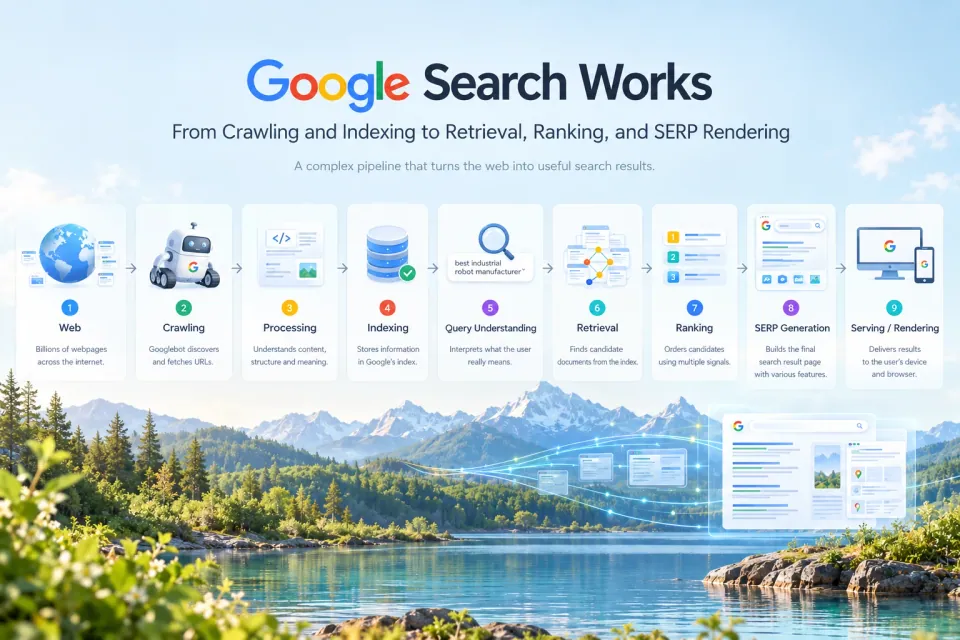
That chain runs on two clocks. The left half happens over minutes to weeks, usually with nobody searching. The right half happens in milliseconds, for one person and one query. No stage guarantees the next one either, so every arrow can fail quietly.
Because Google documents what site owners need to know rather than how its systems are built, this article labels its claims:
| Label | Meaning |
|---|---|
| Documented | Google states it in current Search documentation, linked inline |
| Research | Established in a primary paper, such as the original PageRank paper |
| Concept | A general information retrieval idea used to explain behavior, not a claim about Google’s internals |
| Inference | Industry interpretation: a hypothesis, never a fact |
Where no source is linked, read the claim as Concept or Inference. I don’t assert Google’s internal architecture, and you should distrust anyone who does with confidence.
The Big Picture: Why Google Doesn’t Search the Live Web
The most common misconception about Google is that it “searches the web” when you press Enter. It doesn’t. It searches an index that was built earlier, and the live web gets visited separately by crawlers, on their own schedule.
The design follows from two constraints. Latency is one: a results page has to come back in a fraction of a second, and scoring hundreds of billions of pages per query cannot fit in that window. Cost is the other: judging relevance, duplication, spam, freshness, and page experience is far more work than anyone can redo per search.
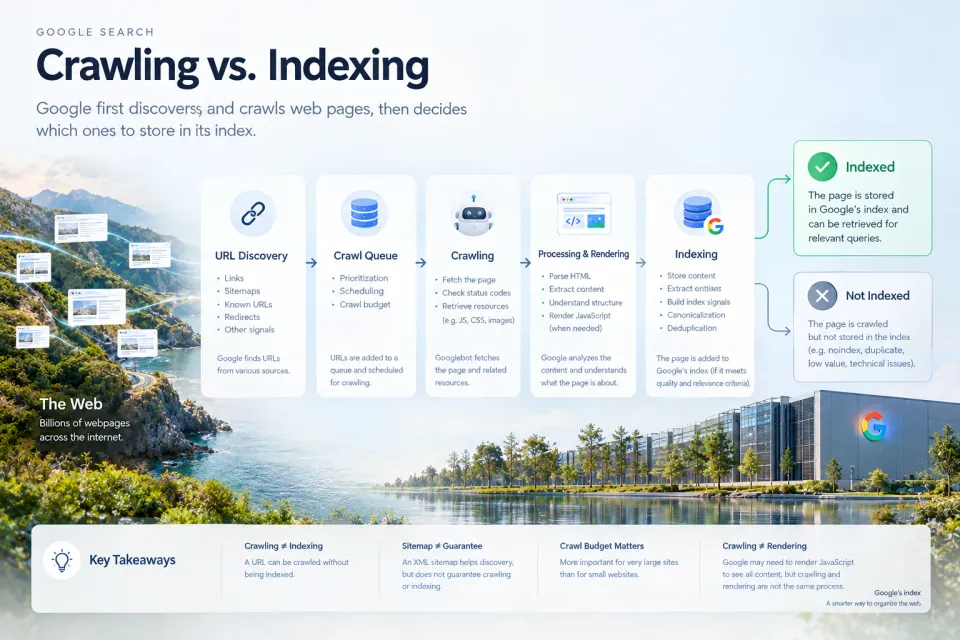
So Google splits the problem in two. Offline, it discovers URLs, fetches them, renders them, processes them, and builds index entries. Online, for one query, it interprets the query, retrieves candidates from the index, orders them, and assembles a results page. Google says outright that crawling is a prerequisite rather than a reward: crawling is “necessary for a page to be in search results,” and it’s “not a ranking signal.”
   CRAWL-TIME (minutes → weeks)        QUERY-TIME (milliseconds)
   ───────────────────────────         ────────────────────────
   Discovery → Crawling → Rendering
                    │
                    ▼
             Processing → Indexing ──▶ Query understanding
                                             │
                                             ▼
                                     Candidate retrieval
                                             │
                                             ▼
                                          Ranking
                                             │
                                             ▼
                                      SERP generation
                                             │
                                             ▼
                                          Serving
A query like best industrial robot manufacturer doesn’t send Google off to read manufacturer sites at that moment. It matches the query against representations of pages that were crawled, ranked, and stored earlier, plus a set of systems that decide which result formats to show. The diagram is a model, not a wiring diagram. Stages overlap and repeat, a ranking system can trigger a fresh crawl, and AI features add a generation step on top of the same index.
Crawling: How Google Discovers and Fetches URLs
Crawling means using automated software to discover web pages and understand them. Googlebot is the crawler most people mean, but Google notes that its crawling infrastructure is “shared across a variety of Google products beyond Search,” which is one reason crawl behavior can look inconsistent. The documentation also moved in late 2025: crawl budget, robots.txt, and status codes now live under developers.google.com/crawling, so old /search/docs/crawling-indexing/ bookmarks are stale.
How Google finds URLs
Google discovers URLs through links it already knows about, through XML sitemaps, and through other sources it doesn’t enumerate publicly. The parts you can act on are stable. Internal links remain the discovery mechanism you control; a page nobody links to has to be found some other way. Sitemaps help with discovery and recrawling, since site owners “can influence how often recrawling happens using sitemap files.” They aren’t a shortcut into the index, though: the crawling and indexing FAQ says a sitemap “does not guarantee indexing or increase your site’s ranking,” and that Google “cannot make predictions or guarantees about when or if your URLs will be crawled or indexed.” One housekeeping note: the sitemap ping endpoint was retired in 2023, so submit sitemaps in Search Console or reference them in robots.txt.
Crawl scheduling and crawl budget
Recrawl frequency follows demand. News homepages may be recrawled every few minutes, while a page that rarely changes can wait a month. Google’s crawl budget guide defines crawl budget as “the set of URLs that Google can and wants to crawl,” which is two variables multiplied:
- Crawl capacity limit: how much Google can fetch without harming your host. Stable response times raise it, and 5xx errors or rate limiting lower it.
- Crawl demand: how much Google wants your URLs, varying “based on a site’s size, update frequency, page quality, and relevance.”
Two caveats matter more than the definition. Google scopes that guide to sites with many rapidly changing pages, so if that isn’t you, crawl budget isn’t your problem. And it governs scheduling, not ranking.
What HTTP status codes tell Google
Status codes are instructions. Google’s documentation on how they affect crawling is unusually specific, and several popular SEO beliefs don’t survive contact with it:
| Response | What Google documents |
|---|---|
| 2xx (200) | Content passes to indexing systems, but “an HTTP 2xx (success) status code doesn’t guarantee indexing” |
| 301 / 308 | Followed as a strong signal that the target should be processed; up to 10 hops |
| 302 / 303 / 307 | Followed as a weak signal that the target should be processed |
| 4xx except 429 | ”All 4xx errors, except 429, are treated the same”: content ignored, not indexed, recrawl frequency decays. 404 and 410 are identical |
| 429 | Treated as rate limiting; Google slows down |
| 5xx | Google slows down; indexed URLs are “preserved in the index, but eventually dropped” if errors persist |
Both of those popular beliefs fall apart here. A 302 doesn’t “lose” ranking signals; it’s a weaker processing signal than a 301, and Google publishes no transfer arithmetic for either. A 410 doesn’t deindex faster than a 404, because Google treats them the same.
robots.txt: blocking crawling isn’t blocking indexing
Disallow prevents crawling, not indexing. Google’s robots.txt specification says Google “can’t index the content of pages which are disallowed for crawling, but it may still index the URL,” which is why blocked URLs sometimes appear with no snippet. Keeping a page out of the index requires noindex, and noindex needs a crawl, because “Google has to crawl the page in order to find the noindex rule.” Using both together is self-defeating.
The supported rules are user-agent, allow, disallow, and sitemap. Google ignores the non-standard crawl-delay, caps the file at 500 KiB, and caches it for up to 24 hours. It isn’t access control either, since the file is public.
Fetching, rendering, and JavaScript
Crawling and rendering are related, but they aren’t the same thing. Google’s myths about crawling page says that “crawling a site involves both retrieving and rendering the content,” so rendering sits inside the crawl stage and its cost counts against crawl capacity.
Google has rendered JavaScript for years, and its guidance keeps drifting toward “normal engineering, not a special SEO mode.” Render or pre-render what matters, keep important resources fetchable, and check what Google sees instead of trusting your browser. Dynamic rendering is still documented as a workaround rather than a recommendation. One warning about a popular mental model: the idea that Google renders pages in exactly “two waves” is an Inference, not documentation.
Keep the verbs apart. Crawling is fetching and rendering a URL. Rendering is executing the page so its content can be seen. Indexing is deciding whether the URL becomes searchable. A URL can be crawled and never indexed, rendered and thrown away, or indexed without readable content, which is what the robots.txt case shows.
For the operational version of this stage, see my technical SEO audit for AI readiness and website crawlability for AI.
Processing and Understanding a Web Page
After a page is fetched and rendered, Google’s systems have to turn HTML into something indexable and retrievable. Google describes this at a high level, and the internal pipeline isn’t public.
What gets extracted
The signal set is consistent across Google’s public guidance:
- Text content, separated from navigation and boilerplate
- Links and anchor text
- Headings and document structure, which identify the page’s topic and sections
- Metadata and structured data: title element, meta description, JSON-LD, microdata, RDFa
- Language and locale signals, used to judge which audience a page suits
- Media such as images and video, along with the context around them
Canonicalization and duplicate content
Few pages exist once. Variants, parameters, and mirror hosts multiply them, and Google clusters the near-duplicates before selecting one canonical URL to represent the cluster. The signals include rel="canonical" annotations, redirects, sitemap entries, and internal links, and Google makes the final call. Its canonicalization documentation reads best as a list of signals you can influence rather than a switch you control. A canonical that points at a URL which redirects somewhere else is one of the most common causes of “not indexed” problems that have nothing to do with content quality.
Deduplication is also part of ranking. The ranking systems guide names a deduplication system that clusters near-identical results, and the crawl budget documentation describes each page being “evaluated, consolidated, and assessed to determine its suitability for the index.”
Entities, structure, and concepts
Retrieval is not string matching. Google documents AI systems that work with concepts and intent instead of keywords. BERT helps the systems “understand how combinations of words express different meanings and intent,” neural matching relates concepts in queries to concepts in pages, and RankBrain is “an AI system that helps us understand how words are related to concepts” (all three are Documented in the ranking systems guide).
Structure carries weight at the page level for the same reason. Clear H2 and H3 sections, explicit entity naming, and consistent terminology leave less ambiguity for those systems to resolve. Structured data helps Google understand a page and can enable rich results, but that’s where its documented purpose ends: Google’s structured data guidelines state that a structured-data issue “doesn’t affect how the page ranks in Google web search.” I went through that distinction in structured data for AI search.
What is not documented
Google doesn’t publish how pages are represented internally, how its understanding models are trained, or what thresholds they use. Claims like “Google stores X per page” are Inference. What you can verify is narrower and still useful: make the main content easy to extract, the structure explicit, duplication impossible to get wrong, and language targeting unambiguous.
Indexing: How Google Organizes the Web
What a search index is
A search index is a structure built for fast lookup. In classical information retrieval (a Concept here, not a claim about Google), the core is an inverted index: a mapping from terms to the documents containing them, plus statistics used for scoring. A lookup returns candidates instead of scanning every document. Google’s index is not a textbook inverted index; it’s a multi-component system holding page representations, signals, and relationships. The goal is the same one, though: retrieve from a huge corpus without reading all of it.
Why the index is not a copy of the web
Three documented behaviors make that clear. Hundreds of near-identical URLs can collapse into a single canonical entry. Pages are “assessed to determine suitability for the index,” so indexing is a decision rather than a receipt. And pages can be crawled and dropped, or never indexed at all. No index size is publicly documented, so any article quoting a number is either citing a very old estimate or making one up.
Why crawled does not mean indexed
This is the distinction that matters most when traffic disappears. Google’s status-code documentation says that after a successful fetch, “the indexing systems may index the content, but that’s not guaranteed.” Crawling is an input; indexing is an outcome.
| Cause | What is happening | The fix |
|---|---|---|
robots.txt disallow | Content can’t be read; the URL may still be indexed without a snippet | Allow crawling, then use noindex if removal is the goal |
noindex directive | Google crawled, read the directive, and excluded the page | Remove the directive; it needs a crawl to take effect |
| Canonical consolidation | Google chose a different URL as representative | Align canonicals, redirects, sitemaps, internal links |
| Duplication or thin variants | The page adds nothing distinct to the cluster | Consolidate or differentiate |
| Technical failure | Soft 404s, client-only content, blocked resources | Fix response behavior and rendering |
| Quality or policy judgment | Scaled, spammy, or unhelpful content | See the spam policies and people-first content guidance |
Search Console names two ambiguous middle states: Discovered – currently not indexed (Google knows the URL and hasn’t crawled it) and Crawled – currently not indexed (Google fetched it and chose not to index it). Neither comes with a documented “wait N days” rule.
Why indexing and ranking are separate systems
Indexing answers one question: can this URL be considered at all? Ranking answers a different one: where should it appear for this query, against everything else that qualified? A page can be perfectly indexed and rank nowhere, because indexing says nothing about relevance, authority, or competition.
That split drives diagnosis. Zero impressions usually points upstream, to discovery, crawling, or indexing. Impressions with a bad position point downstream, to relevance, ranking, or SERP presentation. Confusing the two is how teams end up rewriting titles on pages that were never indexed.
Query Understanding: What Does the User Actually Mean?
A query is not a keyword list. Java can mean an island, a language, or a coffee; apple a company or a fruit. Best industrial robot manufacturer in China carries an implicit comparison, a commercial stage, and a market. Google documents several systems at this layer:
- BERT, which handles “how combinations of words express different meanings and intent,” and is why word order and context matter
- Neural matching, which relates concepts in queries to concepts in pages
- RankBrain, which helps the systems understand how words relate to concepts
- Spelling and synonym handling, visible as the “Showing results for…” line
- Language and locale handling, which shapes the part of the index that becomes relevant
Results also vary by documented context. Relevance “is determined by hundreds of factors, which could include information such as the user’s location, language, and device,” and the structured data guidance notes that results vary “depending on many variables, including search history, location, and device type.” Two people typing the same string don’t get identical pages.
Search intent is an SEO framework, not a Google taxonomy
Informational, navigational, commercial, transactional. That split is an industry planning tool, invented to map content to user goals. It isn’t an official Google classification, and Google doesn’t document ranking differently by those labels. Use it to decide what to write, and don’t describe it as a Google mechanism.
What is documented is more precise. The ranking systems guide names a passage ranking system that identifies individual passages of a page, and the AI features documentation describes query fan-out, where a query gets expanded into related sub-queries. Whatever query understanding does, it works at a finer granularity than “one page per keyword.”
Google doesn’t publish parsing rules, expansion logic, or thresholds, and not every model people assume is in use. MUM, for instance, is listed as “not currently used for general ranking in Search but rather for some specific applications.” Plenty of articles still get that wrong.
Retrieval: How Google Finds Candidate Documents
Why Google cannot score everything
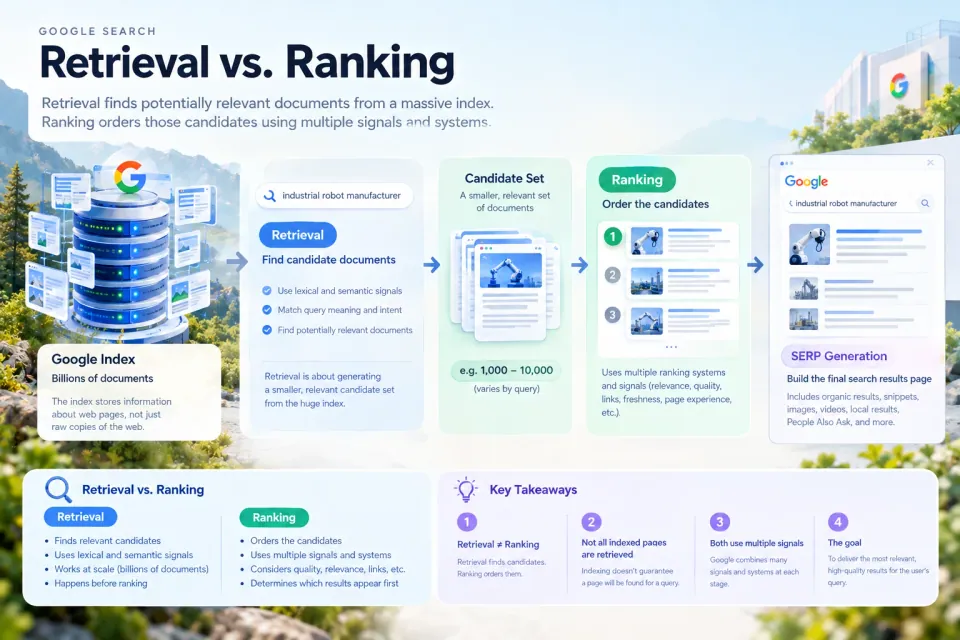
Ranking consumes many signals per document. Running those systems over every indexed page for every query, in a fraction of a second, isn’t possible. So the work happens in two phases. Retrieval narrows the corpus to candidates that are plausibly relevant. Ranking then orders that smaller set with the expensive systems.
Retrieval is about recall: don’t miss the right page. Ranking is about precision: put the right page first. SEO writing about search conflates the two constantly, and that conflation is usually where the bad conclusions start.
Lexical retrieval and inverted indexes
Lexical retrieval matches query terms against index terms. In the classical model (a Concept), an inverted index lets the system intersect posting lists and score the overlaps with statistics such as TF-IDF or BM25. It’s fast and deterministic, and it works well when the query’s words appear in the document. It also fails on paraphrase, vocabulary mismatch, and queries that describe a concept the page never names.
Semantic retrieval and embeddings
Semantic retrieval takes a different route. Queries and documents become vectors, or embeddings, positioned in a space where similar meanings sit near each other. Nearest-neighbor search then retrieves documents that answer a query without sharing its vocabulary (again, a Concept).
This is where SEO writing tends to overreach. Google publishes research in the area, and the AI features documentation describes retrieval-augmented generation relying “on our core Search ranking systems to retrieve relevant, up-to-date web pages from our Search index.” What Google doesn’t publish is the retrieval architecture of Search: which representations it uses, where they live, or how lexical and semantic signals get combined. “Google retrieves pages from vector database X” is Inference dressed as fact.
Hybrid retrieval as a conceptual model
Watch what happens in practice. An exact-match page wins a long-tail query, and a paraphrased page wins a conceptual one. Both signal types look like they’re contributing. A hybrid model (Concept) would look like this:
query
  ├─▶ lexical generation   (terms → posting lists → candidates)
  └─▶ semantic generation  (query vector → nearest documents)
                  │
                  ▼
      merged, deduplicated candidate set
                  │
                  ▼
      candidate representations: page-level, and passage-level
      (per Google's documented passage ranking system)
                  │
                  ▼
             ranking systems
Retrieval vs ranking
| Retrieval | Ranking | |
|---|---|---|
| Question | Which documents could be relevant? | In what order should they appear? |
| Corpus | The whole index | A candidate set |
| Goal | Recall | Precision |
| Signals | Query-document matching | Relevance, quality, links, freshness, page experience, spam, context |
| SEO lever | Topical coverage, terminology, structure | Quality, authority, technical health, competitiveness |
A page can be retrieved and still lose on ranking. It can also be dropped during retrieval, because nothing in its indexed representation connects it to how people phrase the query.
Ranking: How Google Orders the Candidates
There is no single ranking algorithm
Google’s ranking systems guide describes “automated ranking systems that look at many factors and signals about hundreds of billions of web pages.” Two more statements close the question. “We have many ranking signals, and PageRank is just one of those,” and “Google doesn’t accept payment to rank pages higher, and ranking is done programmatically.” “The algorithm” is shorthand for a group of systems that each handle part of the problem, plus core systems that combine them. Ask which single factor matters most and you’re assuming a design Google says it doesn’t use.
The systems Google currently names
The guide lists the systems below. Grouping them is my choice; the names and functions are Google’s.
| Group | Systems |
|---|---|
| Language and intent | BERT, neural matching, RankBrain, MUM (specific applications only) |
| Content quality and originality | Original content, reviews, reliable information, removal-based demotion |
| Structure and consolidation | Passage ranking, deduplication, site diversity (generally no more than two listings per site in top results), exact match domain |
| Freshness and timeliness | Freshness (“query deserves freshness”), local news, crisis information |
| Links | Link analysis systems and PageRank |
| Spam | Spam detection systems, “including SpamBrain” |
Its retired section covers Hummingbird, Panda, and Penguin, along with the helpful content system, which “in March 2024, it evolved and became part of our core ranking systems.”
PageRank and links, carefully
PageRank is both the oldest idea on that list and the most mythologized. It comes from the 1998 paper The Anatomy of a Large-Scale Hypertextual Web Search Engine (Research), which treated a link as a vote weighted by the importance of the linking page:
PR(A) = (1-d) + d (PR(T1)/C(T1) + ... + PR(Tn)/C(Tn))

d = damping factor, "we usually set d to 0.85"
T1..Tn = pages linking to A      C(T) = outlinks on T
The consequences are worth spelling out. Links behave like citations, which is why they still matter. And the formula is a 1998 research artifact; Google says “how PageRank works has evolved a lot since then, and it continues to be part of our core ranking systems.” Nobody outside Google can compute your PageRank today.
Most of what Google documents about links now concerns misuse. Buying or selling links for ranking purposes counts as link spam unless the links carry rel="sponsored", rel="nofollow", or rel="ugc". Google does acknowledge the legitimate case, noting that buying and selling links “is a normal part of the economy of the web for advertising and sponsorship purposes.” Links are still a meaningful signal family. More links isn’t a strategy, though. Editorial citations are, and unqualified paid links are a liability.
E-E-A-T: a quality concept, not a factor
E-E-A-T stands for experience, expertise, authoritativeness, and trustworthiness. It appears in Google’s Search Quality Rater Guidelines, which human raters use to judge whether Google’s systems produce good results. Google is blunt about what E-E-A-T isn’t. The people-first content guidance states that “E-E-A-T itself isn’t a specific ranking factor,” and the SEO Starter Guide answers the FAQ Thinking E-E-A-T is a ranking factor with “No, it’s not.” Google adds that “of these aspects, trust is most important,” and that some topics, which it calls “Your Money or Your Life” or YMYL, warrant extra scrutiny.
The guidelines aren’t an algorithm either. They “are not a guide to ranking first in Google,” and “search raters have no control over how pages rank. Rater data is not used directly in our ranking algorithms.”
None of that makes E-E-A-T pointless. It makes the useful version concrete: real authorship, first-hand experience you can demonstrate, accurate claims, clear sourcing, transparent ownership. Those feed the quality signals Google says it tries to measure. They aren’t a checklist that adds points.
Helpful content and core updates
The helpful content system was folded into core ranking in March 2024, so there’s no standalone “helpful content update” left to chase. The guidance that survived is the people-first framework built on who made the content, how, and why, along with the warning that content produced mainly for search traffic, at scale and without added value, is what Google’s spam policies target as scaled content abuse and site reputation abuse. Core updates are broad by design: “these changes are broad in nature, and don’t target specific sites or individual web pages.” After one, the question worth asking isn’t “which penalty did I get.” It’s “which of my pages are now weaker than the alternatives.”
Page experience and Core Web Vitals
Core Web Vitals measure real-world loading, interactivity, and visual stability. Three metrics currently count:
| Metric | Measures | Google’s stated threshold |
|---|---|---|
| LCP | Loading performance | Within 2.5 seconds |
| INP | Interactivity | Under 200 milliseconds |
| CLS | Visual stability | Under 0.1 |
FID, which plenty of older articles still list, was replaced by INP in March 2024. Page experience is not a rubric containing those numbers. “There is no single signal. Our core ranking systems look at a variety of signals that align with overall page experience.” Google also sets expectations: Search “always seeks to show the most relevant content, even if the page experience is sub-par,” and good Core Web Vitals results “doesn’t guarantee that your pages will rank at the top.” Treat page experience as a tiebreaker and a conversion factor, not a substitute for relevance. My Core Web Vitals and AI SEO post covers the measurement side.
Spam systems
Spam work is its own system family, separate from relevance, and mostly automated. “We detect policy-violating practices both through automated systems and, as needed, human review,” and “SpamBrain is our AI-based spam-prevention system.” The current policies cover cloaking, doorway abuse, hacked content, hidden text and link abuse, keyword stuffing, link spam, scraping, sneaky redirects, and user-generated spam, plus two additions that matter for AI-era publishing: scaled content abuse, which covers “using generative AI tools or other similar tools to generate many pages without adding value for users,” and site reputation abuse. Spam systems remove pages from consideration. They aren’t a boost you can earn.
What Google does not publish
There are no published weights, percentages, thresholds, or per-signal contributions. “Backlinks are 30% of ranking” and “CTR is a ranking factor” are Inference at best. What you have instead is a set of systems that each measure something different, combined by core systems whose arithmetic stays private. You don’t need that arithmetic. You need to know what each family measures and whether your pages satisfy it.
SERP Generation: From Ranked Documents to Search Results
A ranked list is not a results page. The SERP gets composed for the query, and composition depends on the query: Google notes that result appearance varies “depending on many variables, including search history, location, and device type.” The same query can return a map pack on a phone, a shopping carousel on desktop, and a video row for a slightly different phrasing.
Titles, URLs, and snippets
The most visible elements are generated rather than dictated. Title links come from the title element plus other on-page signals, and Google may substitute different text when the title is unhelpful, repetitive, keyword-stuffed, or inconsistent with the page. Displayed URLs and breadcrumbs derive from the URL structure and, where present, breadcrumb markup, and Google may simplify them for readability. Snippets are generated primarily from page content, with the meta description as one candidate source among others.
That last point explains a complaint I hear constantly: a meta description is not a guaranteed snippet. There is no reliable way to force one, and a description written like a keyword list tends to get ignored in favor of a passage quoted from the page.
SERP features, and why composition varies
Beyond ten blue links, results can include featured snippets, People Also Ask, image results, video results, local results and map packs, shopping results, news and Top Stories, sitelinks, and knowledge panels. These formats become eligible when a query matches their intent. Structured data can enable enhanced presentation, but eligibility isn’t appearance: “Using structured data enables a feature to be present, it does not guarantee that it will be present.”
Featured snippets make the point well. Google generates them programmatically, and they can come from a result that isn’t the first organic listing, so “position 1” and “the featured snippet” are different claims. You can’t opt in. The practical route is answering a question directly, in a clearly structured passage near the top of the page.
AI Overviews and AI Mode
AI features changed SERP composition more than anything since the map pack, and they’re also the most speculated-about part of SEO. The documentation is calmer than the discourse. AI features sit on the same foundation: “our generative AI features on Google Search are rooted in our core Search ranking and quality systems,” and retrieval-augmented generation relies “on our core Search ranking systems to retrieve relevant, up-to-date web pages from our Search index.”
There’s nothing special to implement, either: “There are no additional requirements to appear in AI Overviews or AI Mode, nor other special optimizations necessary.” A page has to be indexed and eligible to be shown with a snippet. The formats do differ, since “AI Mode and AI Overviews may use different models and techniques, so the set of responses and links they show will vary.” And the AI-crawler files don’t help: on llms.txt, Google’s generative AI optimization guide states it “will neither harm nor help your site’s visibility or rankings in Google Search, as Google Search ignores them.”
Search Console changed twice in 2026, and both changes matter day to day. There’s now a Search generative AI control in settings, where inclusion is the default, and a Generative AI performance report, announced in June 2026, that reports impressions for AI features. Along with URL Inspection, that’s the most direct evidence available about whether AI features surface your pages. My GEO vs SEO comparison covers how that work overlaps with classic SEO.
Serving and Rendering: What the User Actually Sees
Two rendering events show up in this story, and keeping them apart prevents a lot of bad diagnosis. The first is Google’s rendering during crawling, which helps it understand a page for indexing and happens on Google’s infrastructure. The second is the browser rendering the results page, which happens on the user’s device.
When someone says “my content is rendered by JavaScript,” they usually mean the first. When they say “the layout changed and my ranking dropped,” they mean the second, and a layout change is not a ranking change.
Serving varies by device, since mobile and desktop SERPs differ in feature density, which changes how far down position 4 sits. Layouts are dynamic, with features inserted, expanded, or omitted depending on the query and context. And the delivered HTML is a starting state rather than the finished artifact, because the results page is an interactive application.
So position doesn’t promise visibility. A position-3 listing on a mobile SERP with an AI Overview, a map pack, and a People Also Ask block can sit below the fold. Track rank as a single number without tracking feature presence and you’ll overstate the traffic a position should produce.
A Complete Search Journey
Someone in Shenzhen types best industrial robot manufacturer in China on a phone.
- Query submission. It arrives with context: language, location, device, account state. All of those are documented factors in what comes back.
- Query interpretation. Systems normalize the string, resolve entities (industrial robot manufacturer as a category, China as a market), and read the query as comparison shopping with a commercial stage. If AI features trigger, the query may fan out into sub-queries.
- Candidate retrieval. Lexical and semantic generation pull candidates from the index: pages about industrial robotics, automation suppliers, manufacturers, regional procurement. A page with no indexed representation of those concepts can’t be retrieved, however good it is.
- Ranking. Multiple systems order the set, weighing relevance and intent match, depth and originality, link-based authority, freshness where the query deserves it, page experience, and spam filtering. A manufacturer’s category page can win on relevance and lose on authority, while a directory can win on coverage and lose on the reviews system.
- SERP feature generation. The commercial and local character of the query makes a map pack, a shopping-style block, image results, People Also Ask, and possibly an AI Overview plausible.
- Title and snippet generation. Google builds each displayed title link and snippet from content and metadata. A weak title element gets rewritten, and a keyword-stuffed description gets replaced by a passage from the page.
- Serving. The page is delivered and rendered in the browser, adapted to the device.
- Interaction. The user clicks, scrolls, reformulates, or leaves. Reformulation starts the query-time pipeline over again.
The page itself took a much slower route to be available at step 3, and the two paths meet on the results page:
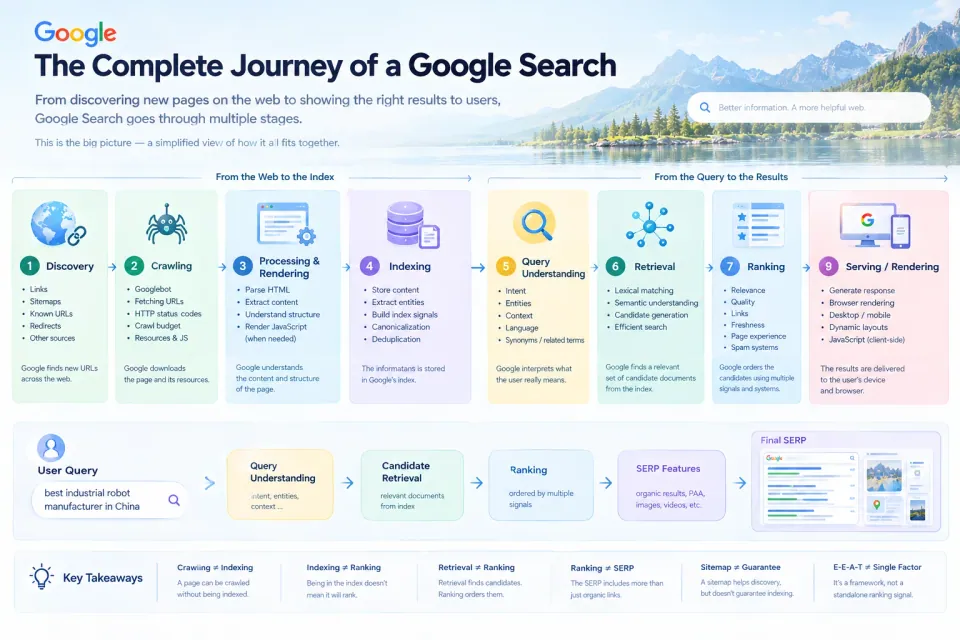
Break something on the left and the page leaves consideration before anyone types the query. Leave something weak on the right and it loses position or clicks once it’s in the running. That division is where a sane diagnostic process starts.
What This Means for SEO Professionals
Every stage has a concrete owner and a concrete failure mode.
| Google stage | SEO concern |
|---|---|
| Discovery | Internal links, XML sitemaps, orphan-page audits |
| Crawling | robots.txt, status codes, crawlability, server behavior |
| Rendering | JavaScript strategy, resource access, server-side rendering |
| Processing | HTML semantics, structure, content extraction, canonical signals |
| Indexing | Noindex, canonicalization, duplication, index coverage |
| Retrieval | Query relevance, topical coverage, terminology, passages |
| Ranking | Quality, relevance, links, freshness, page experience, spam avoidance |
| SERP | Titles, snippets, structured data, feature eligibility |
| Serving | Mobile UX, feature density, SERP presentation |
A troubleshooting order that saves time
Work through the pipeline in order instead of guessing.
  Known to Google?              → Discovery     (internal links, sitemap, orphans)
        ↓
  Crawlable?                    → Crawlability  (robots.txt, firewall, status codes)
        ↓
  Does Google see the content?  → Rendering     (JS dependency, blocked resources)
        ↓
  Indexed?                      → Indexing      (noindex, canonical, duplication)
        ↓
  Understood?                   → Processing    (structure, entities, thin copy)
        ↓
  Relevant for real queries?    → Retrieval     (coverage, intent, terminology)
        ↓
  Competitive?                  → Ranking       (quality, authority, freshness)
        ↓
  Visible on the SERP?          → SERP features (snippets, formats, competition)
        ↓
  Persuasive?                   → Presentation  (titles, snippets, brand)
Each step is checkable. URL Inspection shows whether a URL is indexed and which canonical Google chose. The Page Indexing report groups URLs by state. The Generative AI performance report shows whether AI features surface your pages. The order is also a dependency chain, so fixing a downstream stage while an upstream one is broken produces no measurable change. That’s how teams conclude SEO doesn’t work when they were optimizing a page that was never indexed.
Why “build more backlinks” is the wrong first move
Backlinks work on the ranking stage. If a page is undiscovered, uncrawled, unrendered, or unindexed, links change nothing, because the page isn’t in any query’s candidate set. Even when a page is indexed, links compete with relevance, content quality, freshness, and page experience. PageRank is “just one of those” signals.
So ask which stage you’re actually fixing. A link campaign for a page blocked by a stray noindex isn’t a campaign; it’s a refund request waiting to happen. For the crawl-level checks, see my Screaming Frog SEO audit guide, and the AI SEO knowledge cluster collects the related guides on this site.
Common Misconceptions About Google Search
| Misconception | What the documentation supports |
|---|---|
| Crawled means indexed | After a successful fetch, “the indexing systems may index the content, but that’s not guaranteed” |
| Indexed means ranked | Indexing determines eligibility; ranking is a separate, competitive process |
| Google has one ranking algorithm | Google documents many ranking systems; PageRank is “just one of those” signals |
| More backlinks automatically means higher rankings | Links are one signal family, and unqualified paid links are link spam |
| The meta description becomes the snippet | Snippets come primarily from page content; the description is one candidate source |
| Google searches the live web for every query | Results come from an index built in advance by crawling |
| Core Web Vitals alone determine rankings | ”There is no single signal,” and relevance is still prioritized “even if the page experience is sub-par” |
| A sitemap guarantees indexing | Sitemaps help discovery; Google states they do not guarantee indexing |
| E-E-A-T is a numerical ranking factor | ”E-E-A-T itself isn’t a specific ranking factor”; the FAQ answer is “No, it’s not” |
| A 302 loses signals that a 301 passes | 301/308 are strong and 302/303/307 weak processing signals; no transfer arithmetic is published |
| A 410 deindexes faster than a 404 | ”All 4xx errors, except 429, are treated the same” |
| robots.txt removes a page from Google | Disallow blocks crawling; the URL may still be indexed without a snippet |
| MUM powers general ranking | Google lists MUM as “not currently used for general ranking in Search” |
Conclusion
The model worth keeping is the whole chain, not the single verb:
Discover → Crawl → Process → Index → Understand Query → Retrieve → Rank → Generate SERP → Serve
Google names three stages (crawling, indexing, serving) and warns that not all pages make it through each one. Everything SEOs argue about lives in the gaps between them: what gets discovered, what gets rendered, what survives consolidation, what retrieval considers relevant, what ranking systems prefer, and what the results page decides to display.
That reframing changes the work. Modern SEO isn’t “ranking a page.” It’s making content:
- Discoverable: linked, listed, reachable
- Crawlable: allowed, responsive, free of accidental blocks
- Renderable: visible to Google and to users, with or without JavaScript
- Understandable: structured, specific, unambiguous
- Indexable: canonical, distinct, eligible
- Relevant: organized around how people actually ask
- Competitive: better than the alternatives, not merely present
- Useful: worth the click, and worth trusting
Nine stages, eight properties, one habit. Find out which stage is broken before optimizing the one you find most interesting.
Sources and Further Reading
Google documentation below was consulted in October 2026. This area changes: crawling documentation moved to a new section of Google’s developer site in late 2025, the helpful content system was folded into core ranking in March 2024, and AI feature guidance was added in 2026. Google doesn’t publish implementation details, so nothing here should be read as a description of its internal code.
How Search works (documented stages)
- In-depth guide to how Google Search works: the three-stage model of crawling, indexing, and serving
- Google Search crawling and indexing FAQ: what Google will and will not guarantee
- SEO Starter Guide: includes the direct E-E-A-T answer
Crawling, rendering, robots.txt, status codes
- Things to know about Google’s web crawling: discovery, recrawl cadence, shared crawling infrastructure
- Optimize your crawl budget: capacity limit vs. demand, consolidation, index suitability
- How HTTP status codes affect Google’s crawlers: 2xx through 5xx, redirect strength, 404 vs. 410
- How Google interprets the robots.txt specification: supported rules, size limit, caching, fetch failures
- Myths and facts about crawling: crawling vs. rendering,
crawl-delay,nofollow - JavaScript SEO basics: what Google renders and how to test it
- Consolidate duplicate URLs: canonicalization signals
- Qualify your outbound links: sponsored, nofollow, ugc
Indexing, content quality, and policy
- Robots meta tag and X-Robots-Tag specifications:
noindex,nosnippet, and related directives - Creating helpful, reliable, people-first content: E-E-A-T, YMYL, who/how/why
- Google Search’s guidance on using generative AI content: what is and is not against policy
- Spam policies for Google web search: scaled content abuse, site reputation abuse, link spam
- Search Quality Rater Guidelines: the human-evaluation document often mistaken for a ranking algorithm
Ranking systems and signals
- A guide to Google Search ranking systems: current and retired systems
- Google Search’s core updates and your website: why updates are broad
- Reviews system: one of many factors
- Google Search spam updates and your site: SpamBrain and spam updates
- Understanding page experience: “there is no single signal”
- Understanding Core Web Vitals and Google search results: LCP, INP, CLS and their thresholds
- Influence your byline dates: why Google uses several date signals
- The Anatomy of a Large-Scale Hypertextual Web Search Engine (Brin & Page, 1998): the original PageRank paper
Structured data, SERP features, and AI features
- General structured data guidelines: eligibility, not ranking, and not a guarantee
- Introduction to structured data: markup types and intended use
- AI features and your website: AI Overviews, AI Mode, eligibility
- Optimizing your website for generative AI features on Google Search: the 2026 guidance, including
llms.txt - Introducing generative AI performance reports in Search Console: measuring AI feature impressions
- Managing multi-regional and multilingual sites: locale signals and ignored geotargeting tags